

Cellular networks provide internet connectivity where wired access is unavailable, enabling remote monitoring, diagnostics, and troubleshooting of building automation and industrial control systems.
The Skorpion Gigabit Cellular IP Router (EIGR-C2) enables secure remote access over cellular networks using OpenVPN technology and supports Contemporary Controls' VPN solutions: RemoteVPN, Self-HostedVPN, and BridgeVPN.
The EIGR-C2 is a high-speed router that connects cellular and 10/100/1000 Mbps IPv4 networks through an integrated LTE modem. Supporting OpenVPN client and server functionality, the router works with Contemporary Controls' RemoteVPN and Self-HostedVPN solutions as an OpenVPN client and with BridgeVPN as an OpenVPN server.
RemoteVPN
RemoteVPN is a subscription service that provides secure remote access without requiring users to install or maintain their own VPN server. The VPN server is hosted and managed by Contemporary Controls and enables secure communication between OpenVPN clients. A workstation or mobile device running OpenVPN client software connects to the RemoteVPN server over the internet, while an OpenVPN router at the remote site completes the connection.
For remote installations, the EIGR-C2 provides secure connectivity over cellular networks, while the EIGR-V Skorpion Gigabit IP Router provides similar functionality over wired Ethernet internet connections. The EIGR-C2 includes four LAN ports and an LTE cellular WAN connection, although one Ethernet port can also be configured as the WAN interface when cellular connectivity is not required.
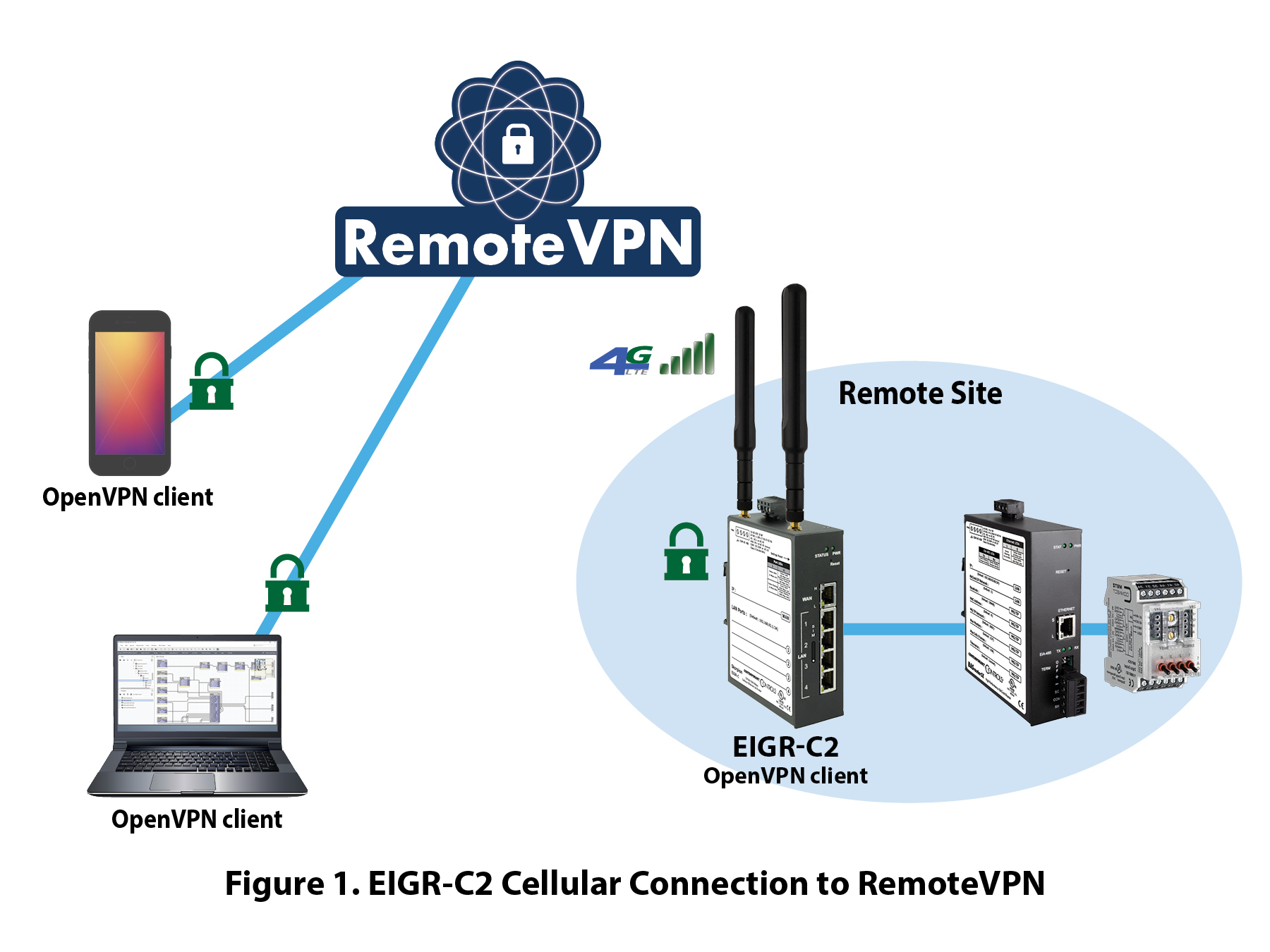
In Figure 1, a PC running OpenVPN client software behind a firewall connects to the RemoteVPN server over the internet. At the remote site, the EIGR-C2 connects to the Internet via its cellular modem and communicates with BAS devices connected to its LAN port. Both the remote router and PC securely connect to the RemoteVPN server, eliminating the need for port forwarding or firewall modifications.
Self-HostedVPN
For users who prefer to manage their own VPN server, Self-HostedVPN uses an EIGR-V router configured as an OpenVPN server. The solution supports both wired EIGR-V and cellular EIGR-C2 routers configured as OpenVPN clients. It can accommodate up to 15 OpenVPN client routers and up to 15 OpenVPN clients running on workstations or mobile devices.
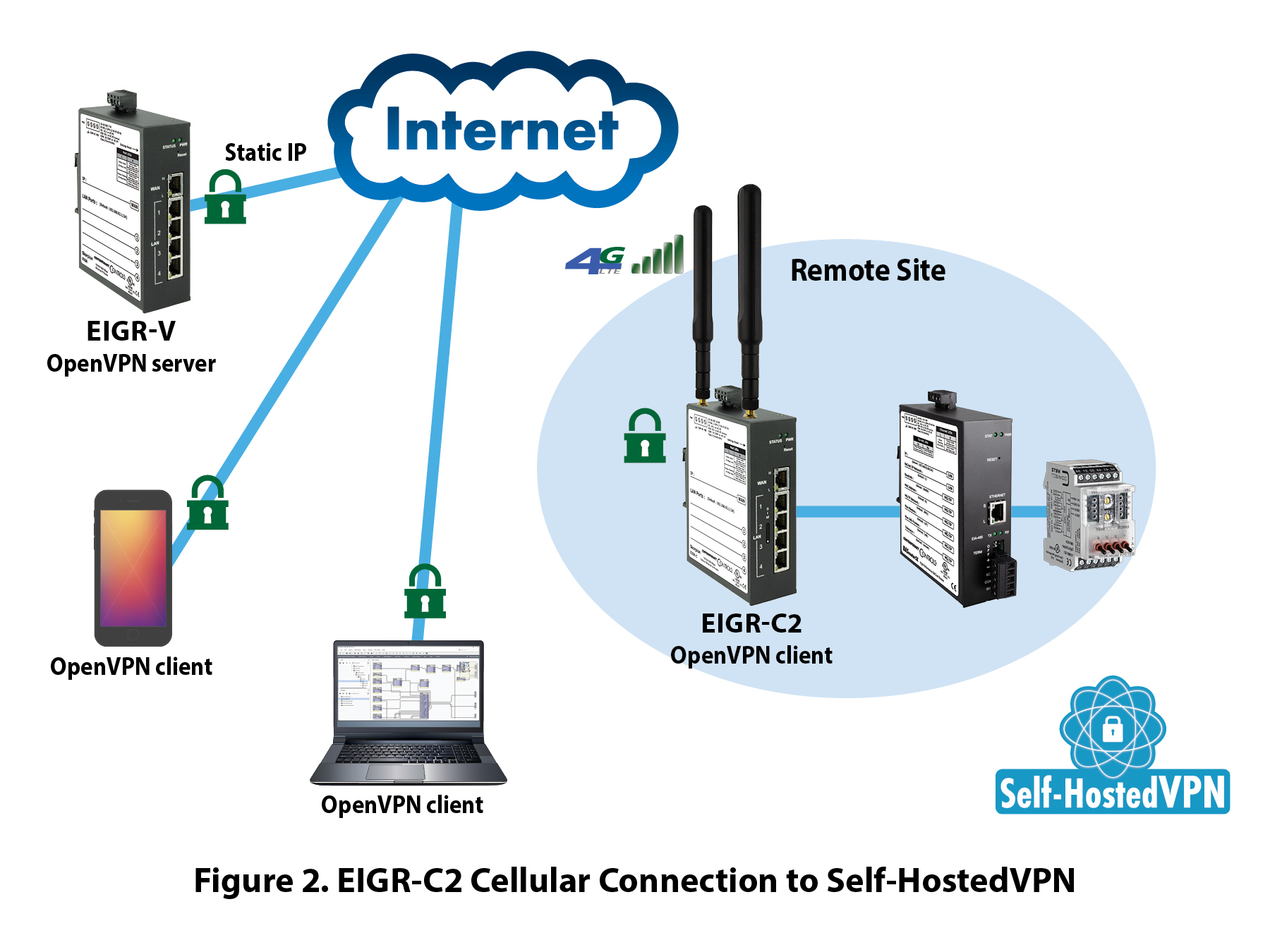
In Figure 2, a PC running OpenVPN client software behind a firewall connects to the Self-HostedVPN server via the internet. At the remote site, the EIGR-C2 connects to the internet through its cellular modem and communicates with BAS devices connected to its LAN port. Secure VPN communication is established without requiring NAT configuration or port forwarding.
BridgeVPN
For single-site remote access applications, BridgeVPN uses an EIGR-VB or EIGR-C2 configured as an OpenVPN server and supports up to 10 VPN clients on Windows or Linux PCs.
Unlike routed VPN connections, BridgeVPN bridges VPN clients directly to the local network. Connected PCs receive IP addresses from the LAN subnet and operate as if locally connected. This allows multicast and broadcast traffic, including BACnet discovery messages, to pass through the VPN tunnel. As a result, BACnet client applications can discover and communicate with remote BACnet devices without requiring a BBMD.
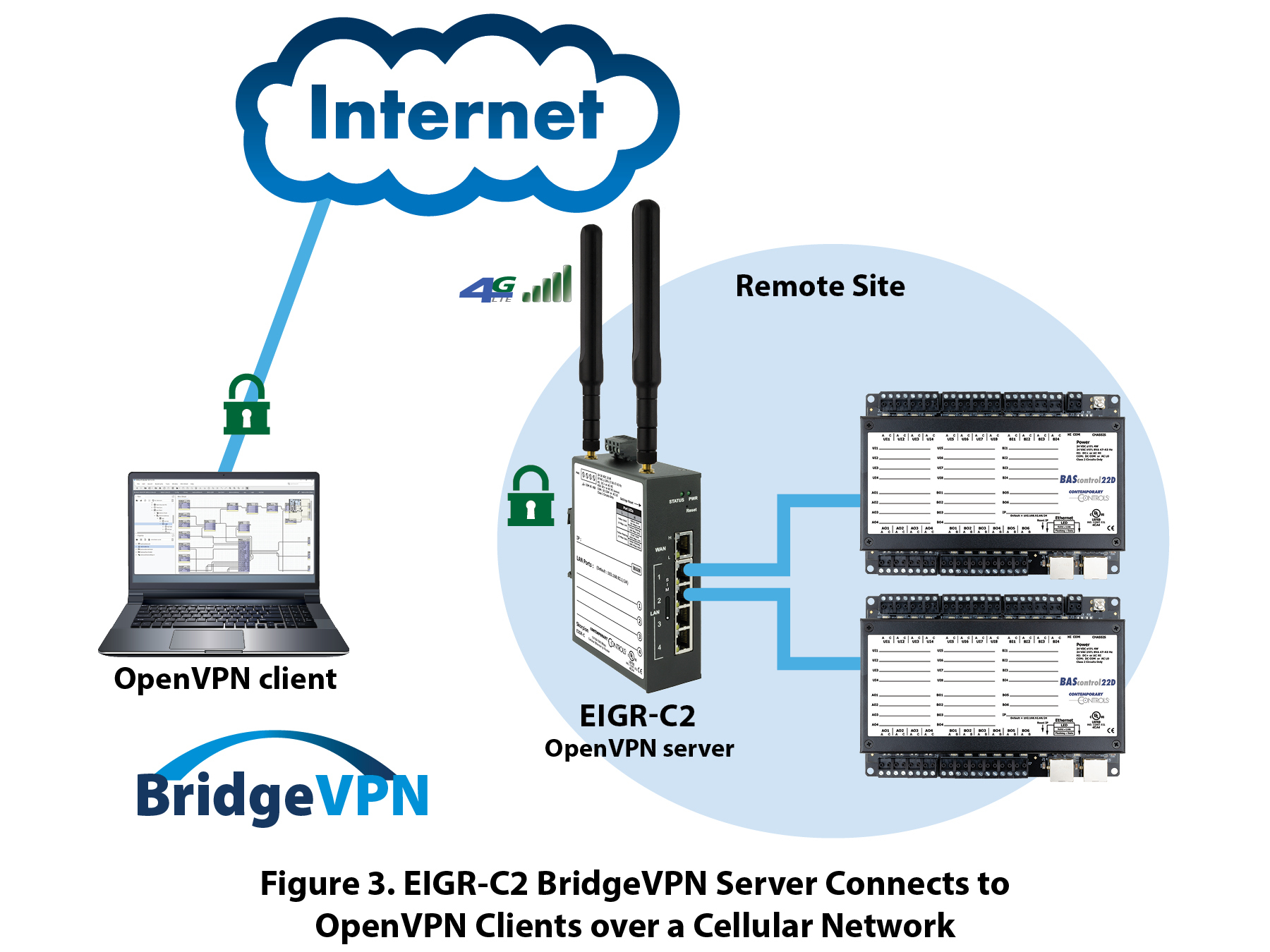
In Figure 3, a Windows PC running OpenVPN client software behind a firewall connects to the EIGR-C2 BridgeVPN server over the internet. At the remote site, the EIGR-C2 connects to the internet through its integrated cellular modem and provides access to BAS devices connected to its LAN ports.

