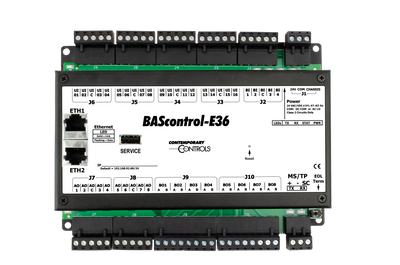
When Francisco Barrantes attended AHR Expo 2025, he entered Contemporary Controls' 50th Anniversary Sweepstakes and won a BAScontrol-E36 36-point Edge Controller.
He quickly put it to work to develop an HVAC training module which continues to evolve with ongoing enhancements and new integrations.
Barrantes is a BMS Design Engineer at Asesoría en Automatización Industrial S.A. (AAISA) in Costa Rica, with more than 35 years of experience in building automation and a dedication to training and education.
"Once I had the controller in my hands, I began to think about how to use it proactively in my training for mechanical, electrical, and control engineers," Barrantes said.
Barrantes designed an HVAC demonstration unit that simulates a variable static pressure control system, similar to those used in air handling units (AHUs) serving variable air volume (VAV) boxes in clean-room and controlled environments.
“Users can turn equipment on and off, adjust setpoints, graph process variables and see exactly how control strategies react in real time, making this an ideal teaching tool,” said Barrantes.
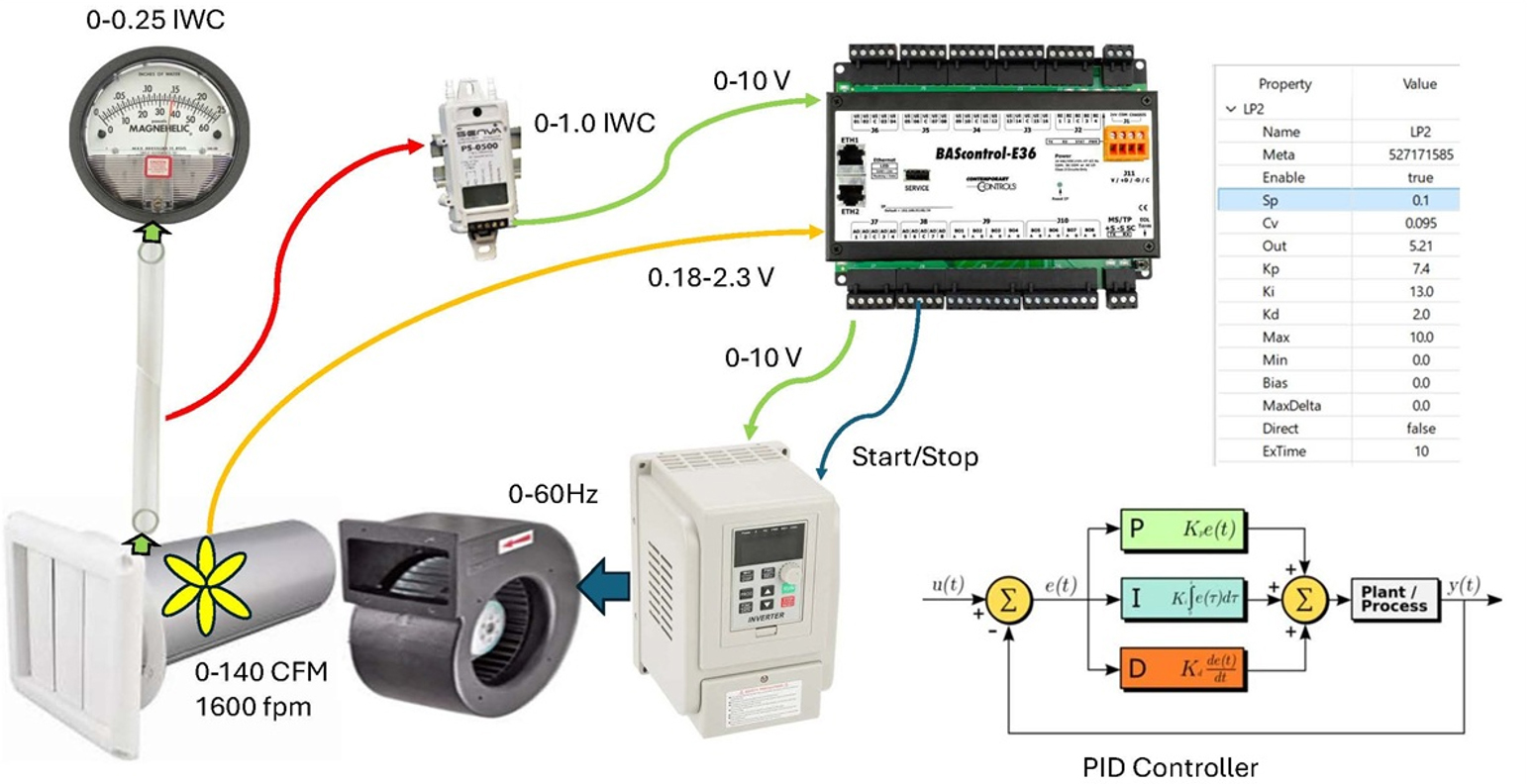
Block diagram PID demonstrator
Using a centrifugal fan, small ductwork, variable louver, and variable speed drive (VFD), the system reliably simulates static pressure between 0–0.5 inches of water column (IWC)—a common pressure measurement in clean room environments. At the core, the BAScontrol-E36 runs PID control loops programmed using Contemporary Controls' Sedona Application Editor (SAE), allowing users to adjust setpoints, visualize system response, and observe how the controller maintains pressure despite disturbances.
The platform has continued to evolve well beyond the initial build. Barrantes expanded the demo to showcase BACnet MS/TP interoperability, integrating secondary DDC controllers from multiple manufacturers—including DELTA Controls, Johnson Controls, and PRICE—as remote I/O devices. These integrations demonstrate long-distance MS/TP communication, multi-vendor compatibility, and real-world read/write control using Sedona programming framework.
Most recently, the project bridged building automation and industrial automation by connecting the BAScontrol-E36 to a SCADA network. Barrantes connected the BAScontrol-E36 via BACnet/IP to Inductive Automation’s open-source SCADA platform, Ignition SCADA, through an OPC Unified Architecture link. In this scenario, the SCADA is the BACnet server and the BAScontrol-E36 is the BACnet client. This integration highlights how modern BAS platforms can interact with open, industrial-grade SCADA systems, an increasingly valuable skill set for today’s engineers.
With interactive web dashboards, wireless access, trend graphs, and multi-vendor integration, the HVAC demo has become a powerful training and knowledge-sharing tool for the BAS/BMS community. As Barrantes continues testing and adding new capabilities, the project stands as a practical example of open systems, interoperability, and applied HVAC control theory in action.